National Hate Crime Awareness Week | 10–17 October 2026
There is something unsettling about the times in which we are living.
Across our country, public debate can feel increasingly heated, divided and unforgiving. Conversations about immigration, race, religion, identity, belonging and difference can quickly become polarised. Social media allows opinions to be broadcast instantly to thousands of people, sometimes with little consideration for the impact those words may have on others.
For those of us working with communities affected by racism and discrimination, this matters.
Social media can be a powerful force for connection. It gives people a voice, enables communities to organise and allows experiences that might otherwise go unheard to be shared. Yet it can also amplify racist, prejudiced and bigoted views, giving them a visibility and reach they might not otherwise have. When hostile messages appear repeatedly online, they can create the impression that hatred is more widespread than it is. For those on the receiving end, however, the impact is real. Repeated exposure to hateful language can leave people feeling unwelcome, anxious about their safety and uncertain about whether they truly belong in the communities they call home.
The latest national hate crime statistics provide a stark reminder that we cannot afford to ignore this challenge.
According to the Home Office’s Hate Crime, England and Wales, year ending March 2026, police recorded 146,825 hate crimes in England and Wales in the year ending March 2026. This represents a 7% increase on the previous year. Race-related hate crimes increased by 9%, reaching 107,926 offences, while religious hate crimes rose by 13%, to 11,419. Within religious hate crime, offences targeting Muslim people increased by 15%, and those targeting Jewish people rose by 10%.
Race accounted for 74% of recorded hate crimes in the latest reporting year. These figures are deeply concerning. They remind us that hostility directed at people because of who they are remains a serious challenge for our society. They provide a clear warning that the response to hate and prejudice must remain a priority.
Behind every statistic is a person
It is easy to discuss hate crime through numbers, percentages and annual reports. But behind every incident is a person whose dignity, security and sense of belonging may have been affected.
Behind a racist comment may be a child who hears it and wonders what it says about them. Behind an online threat may be a family that becomes anxious about its safety. Behind repeated prejudice may be someone who starts avoiding particular places, withdrawing from conversations or questioning whether they are welcome in the place they call home. These experiences can affect individuals, families and whole communities. They can undermine trust, damage relationships and make people feel that their experiences are invisible or that speaking out will make little difference.
This is particularly important in Suffolk.
Suffolk is home to people of different ethnicities, faiths, cultures and backgrounds. They live, work, study, raise families and contribute to our economy, public services, schools, voluntary organisations and community life. Our diversity is part of the fabric of the county, and everyone deserves to feel safe, respected and valued here. Yet we must recognise that people who experience racism and other forms of prejudice can sometimes feel isolated, unheard or uncertain about where to turn for support. We must not allow these experiences to become an accepted part of everyday life.
A shared responsibility to challenge hate
National Hate Crime Awareness Week is not simply about highlighting the problem. It is about considering what we can do, individually and collectively, to address it.
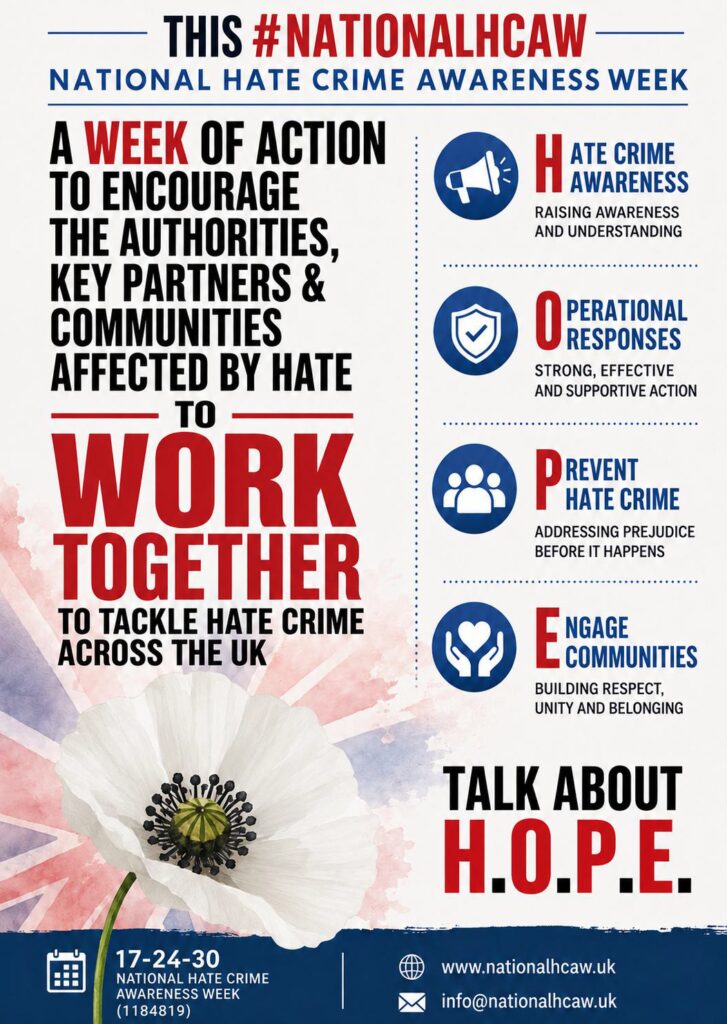
The national H.O.P.E. campaign (Hate Crime Awareness, Operational Responses, Prevention and Engagement) provides a useful framework. It reminds us that tackling hate requires awareness, effective responses, prevention and meaningful engagement with communities.
At the Ipswich and Suffolk Council for Racial Equality (ISCRE), we believe that community solidarity is one of the most powerful responses available to us. Solidarity does not mean that we must agree on everything. Nor does it mean that we cannot have difficult conversations about immigration, integration, religion, public services, inequality or the future direction of our country. A healthy democracy depends on our ability to disagree, question and debate. But disagreement must never become an excuse for dehumanising people. We can challenge ideas without attacking individuals. We can debate policies without demonising communities. We can express strong views without resorting to racism, religious hatred or prejudice. The distinction matters. We must be able to discuss difficult issues openly while recognising the equal dignity and humanity of every person. And when someone is targeted because of who they are, we should not simply look away. We should stand together.
Small actions can make a real difference
Building communities where hate has no home does not rest solely with the police, public bodies or organisations working to promote equality. It is a shared responsibility, and each of us has a part to play.
That might mean:
Speaking up safely. Challenging racist or prejudiced language when it is safe and appropriate to do so, and making clear that such behaviour is not acceptable.
Supporting those affected. Checking in with someone who has experienced an incident, listening without judgement and helping them access appropriate support.
Reporting hate. Reporting hate crime to the police where appropriate and seeking advice from trusted support organisations. Online hate can also be reported to the relevant platform. Avoid sharing harmful content unnecessarily, even when the intention is to condemn it, as doing so can amplify its reach.
Teaching respect. Helping children and young people understand difference, challenge stereotypes and recognise the importance of treating others with dignity.
Strengthening community connections. Taking part in local activities, supporting organisations that work against hate and creating opportunities for people from different backgrounds to meet, listen and learn from one another.
Making inclusion visible. Ensuring that our workplaces, schools, public services, community groups and neighbourhoods communicate clearly that everyone deserves to belong.
These actions may seem small, but together they help shape the culture of our communities. They demonstrate to those affected by hate that they are not alone, and they reinforce the message that prejudice will not be accepted as the norm.
The voice of solidarity must be heard
Those of us who reject racism and prejudice should never underestimate the importance of making our values visible. The people who shout the loudest online do not necessarily represent the majority. There are many people across Suffolk who believe in fairness, decency, respect and the fundamental principle that every person should be able to live without fear of being targeted because of who they are.
But good intentions alone are not enough. If we want our communities to be places where everyone feels welcome, we must be prepared to demonstrate those values through our words, decisions and actions. That means standing alongside people who experience racism, discrimination and hate. It means listening to their experiences, taking concerns seriously and ensuring that appropriate support and responses are available. It also means recognising that building trust takes time, consistency and a willingness to work together.
As we mark National Hate Crime Awareness Week, we invite individuals, families, communities, businesses, schools, public bodies and voluntary organisations across Suffolk to reflect on what each of us can do to make a difference.
We cannot control everything that is said online or every action taken by others. But we can choose what we amplify. We can choose what we share. We can choose whether we remain silent or show solidarity. And we can choose what kind of communities we want to build for ourselves, our children and future generations.
National Hate Crime Awareness Week describes its ambition as creating a “Safe Place for All.” That is an ambition worth sharing, and one that requires all of us to play our part. Ultimately, tackling hate is not only about confronting those who promote it. It is also about strengthening the relationships, values and collective resolve of those who believe that there is a better way.
Let us make that voice heard.
Let us stand together.
Let us make Suffolk a place where hate has no home.